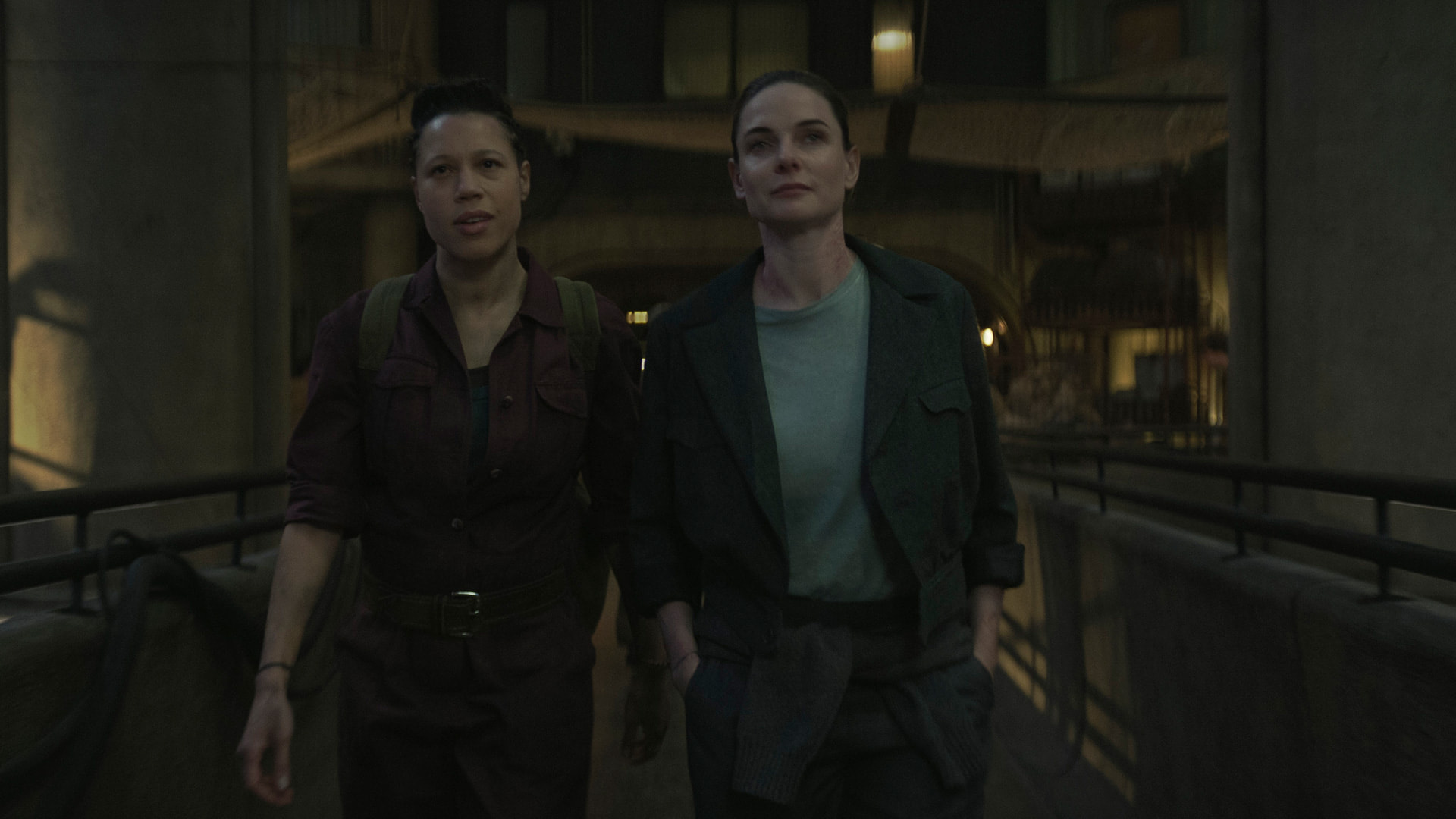
Shirley Campbell and Juliette Nichols walk through Silo 18 as they work to stop the Safeguard.
Apple TV turned weekly releases, an engaged author, and 15-year-old literary IP into a fan ecosystem that doesn’t stop when the finale ends.
Hours after Apple TV wrapped the Season 3 finale of Silo, the streamer gave its audience something increasingly valuable in the streaming era: certainty. The fourth and final season will premiere July 9, 2027. Apple announced the date the same day the Season 3 finale arrived, along with a first look at the final chapter. There would be no indefinite wait to learn the show’s fate, no wondering whether the story would be completed. The audience knew when the doors to the Silo would open again.
That matters because Apple has accomplished something with Silo that every streamer wants but relatively few shows achieve: It has built an audience that doesn’t appear ready to move on when the season ends. Silo has somehow resisted being replaced. The evidence isn’t confined to viewing itself. It’s in the fan theories that filled social media between episodes, the fierce protection against spoilers, the unusual accessibility of author Hugh Howey and, now, renewed interest in the books that started the story 15 years ago. Together, they offer a useful lesson in how weekly television can become an ecosystem rather than simply another title in a streaming queue.
Apple officially dated Season 3 episodes for Fridays, with one new episode scheduled each week from July 3 through Sept. 4. But U.S. viewers following the series closely knew episodes became available Thursday evening. Thursday night became Silo night. I had access to advance screeners as an entertainment writer, but what interested me more was watching the wider Silo community gather on Threads each week. Viewers would announce that they were about to watch, almost as a warning that commentary was coming. Threads’ “Mark as Spoiler” feature became a community safeguard. People took those spoilers seriously. That behavior illustrates one of the advantages of the weekly release model. A binge release can generate an enormous burst of attention. A weekly mystery gives an audience time to speculate, argue, rewatch and recruit other viewers into the conversation.
With Silo, every answer generated new questions. Fans had days to examine scenes, debate theories and search for clues before the next episode arrived. The conversation wasn’t merely something happening after Silo. It became part of watching Silo. Then there was Hugh Howey. Howey didn’t simply write Wool, Shift and Dust, sell the adaptation rights and disappear behind Hollywood’s curtain. He participated in the social conversation around the series, responding to fans and commenting on theories without simply giving away the answers. I experienced that accessibility firsthand. Howey replied directly to me more than once on Threads and, at one point, indicated that he was interested in reading my upcoming recap and review.
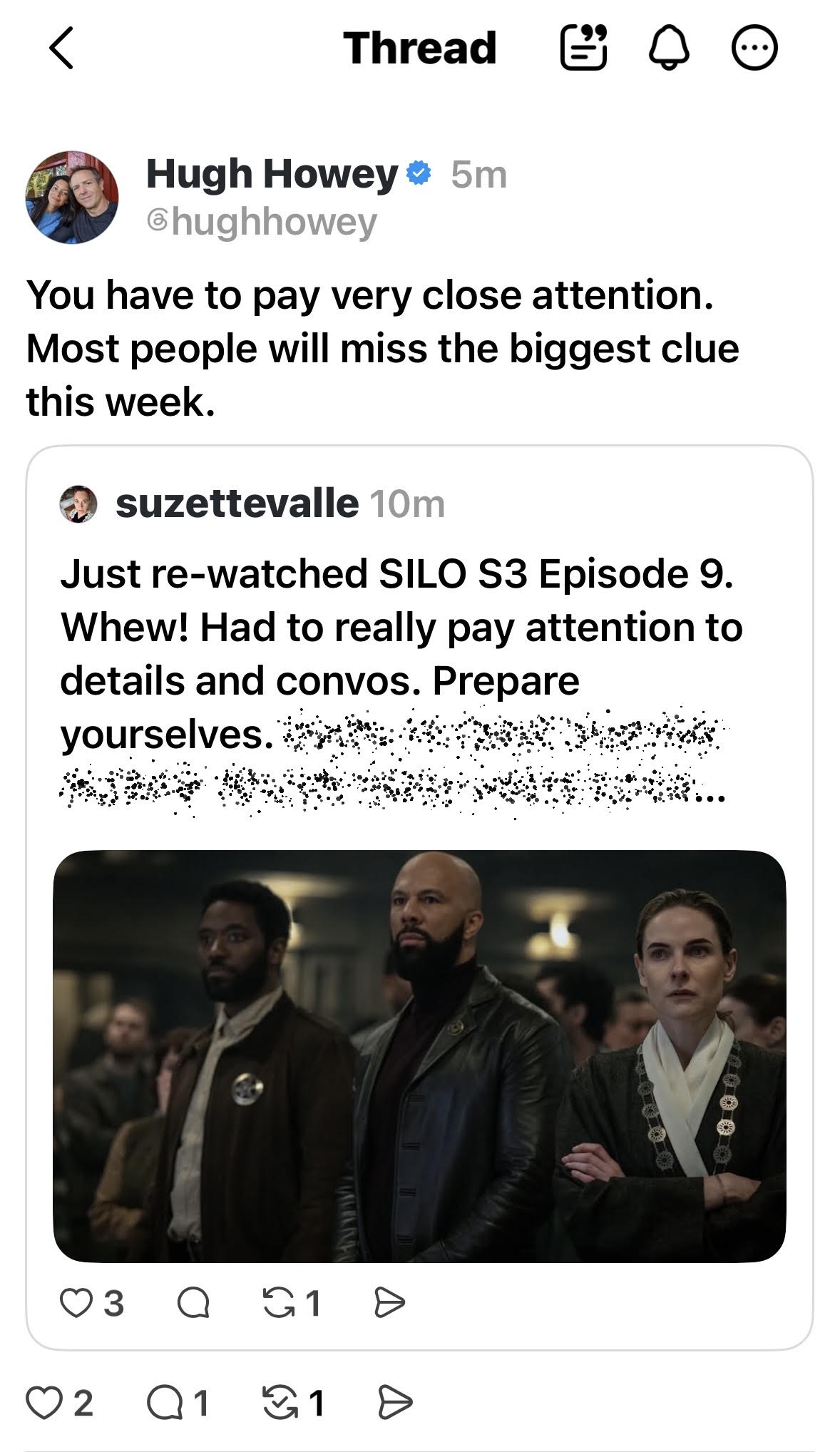
Silo Author Hugh Howey Replies to Suzette Valle on Threads
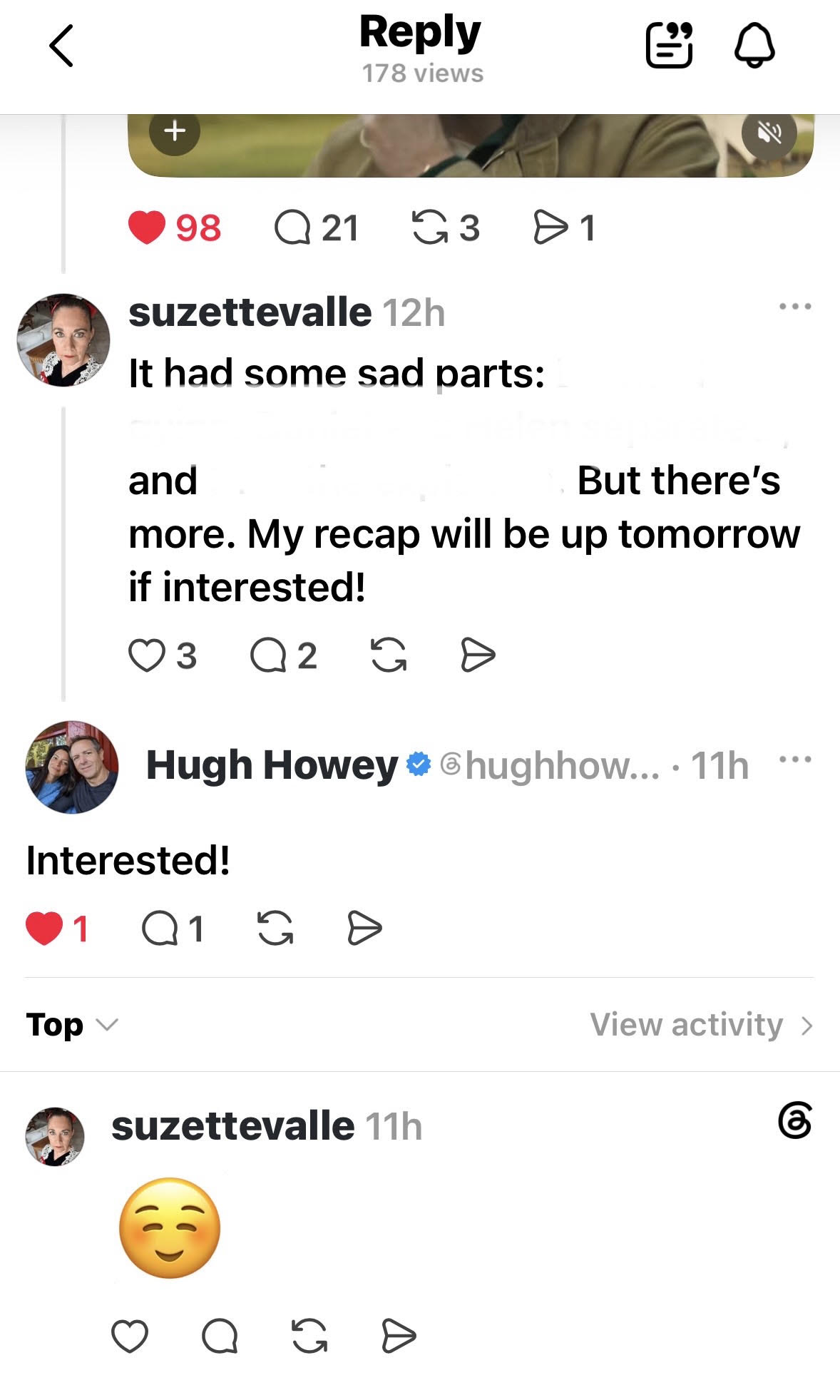
For an entertainment writer accustomed to covering the finished product from the outside, the exchange was striking. The person who created this fictional universe was participating in the same conversation taking place among the people watching its television adaptation.
That collapses a boundary that Hollywood has traditionally guarded carefully. For a series built around locked doors, restricted information and institutional secrecy, Silo has produced an unusually open community outside the screen. And that community now has somewhere to go during the long wait for Season 4.
Back to the books. Just four days after the Season 3 finale, the audiobook of Wool appeared at No. 10 on Apple Books’ U.S. Top 10 audiobook chart. The age of the underlying property makes that ranking particularly interesting. Howey first self-published Wool in 2011. Fifteen years later, the story that launched the Silo universe was sitting among the country’s Top 10 audiobooks.
A chart position alone can’t tell us how many of those listeners arrived because of the television series, and it would be a mistake to attribute the ranking entirely to Apple. But the timing mirrors what has been happening among fans online: Viewers who aren’t ready to leave this universe are talking about reading, or rereading, Wool, Shift and Dust. The books aren’t simply source material anymore. They’re a bridge between seasons.
That creates an interesting cycle for established intellectual property. A 2011 self-published story becomes a book trilogy, the trilogy becomes a prestige television series, and the television series sends a new generation of consumers back toward the original books.
Rather than exhausting the underlying IP, a successful adaptation can renew it. There is another reason the Silo ecosystem works: The story is particularly well suited to the moment in which audiences are watching it. The series revolves around information control, technological power, institutional secrecy and people attempting to understand systems designed to be incomprehensible to them. Those ideas don’t require much translation in 2026. Audiences are living through their own debates about artificial intelligence, algorithms, institutional trust and who controls the information reaching them. Juliette Nichols, played by Rebecca Ferguson, gives those anxieties a human center: an engineer who recognizes that something doesn’t make sense and refuses to stop asking why.
That’s fertile territory for serialized television because the central mystery isn’t merely, “What happens next?” It’s, “What is actually true?” That question can sustain years of storytelling — and years of audience conversation — when viewers trust that answers are ultimately coming. Which makes Apple’s decision to provide a firm date for the final season particularly smart. Season 4 isn’t an abstract promise somewhere in the streaming future. The audience knows the story returns July 9, 2027, and Apple has already provided a glimpse of what’s coming.
The wait itself can now become part of the experience. There will be theories, rewatches, and new readers discovering Wool, Shift and Dust. And there will almost certainly be another round of debates over what Hugh Howey may or may not be telling his followers. The lesson for streamers isn’t simply that weekly releases are better than binge drops. Different shows demand different strategies. It’s that audience retention begins when a series gives viewers reasons to remain engaged after the credits roll.
Silo has a weekly viewing ritual, mysteries built for conversation, literary source material that extends the experience, a creator willing to interact with the audience and, now, a firm date for the conclusion.
Apple didn’t just give Silo viewers another season. It gave them somewhere to go while they wait for it.




Speak Your Mind